Onect
Designing a legal tech platform to simplify the most document-heavy visa process in the U.S.
My role
Product Designer
Duration
August 2025 – March 2026 (8 months)
Team
2 product designers, 2 motion designers
Skills
Design system, User research, UX/UI, Vibe coding

Overview
A better way to prepare an O-1 visa petition
Applying for an O-1 visa is like trying to prove you're extraordinary while drowning in paperwork. Applicants are left figuring out what evidence they need and how to build a convincing case. Meanwhile, attorneys are buried in documents, cross-checking details, and trying to catch every little mistake before a petition goes out. Not exactly a smooth process for anyone involved.
So we built Onect: an AI-native legal tech platform designed to bring the whole process into focus. A clearer roadmap for applicants, a smarter way for attorneys to review cases, and a little less chaos for everyone.
What is an O-1 visa?
The O-1 is a U.S. work visa for individuals with extraordinary ability, requiring 100+ pages of evidence and up to a year of preparation before a decision is even made.
Achievement
UX Design Awards 2026
Recognition
Recognized by the UX Design Awards for rethinking the legal tech experience.
70% Faster Document Reviewing
1 min 28 sec → 26 sec
Streamlined document reviewing from nearly 90 seconds to just 26 seconds.
80% Better Legal Document Comprehension
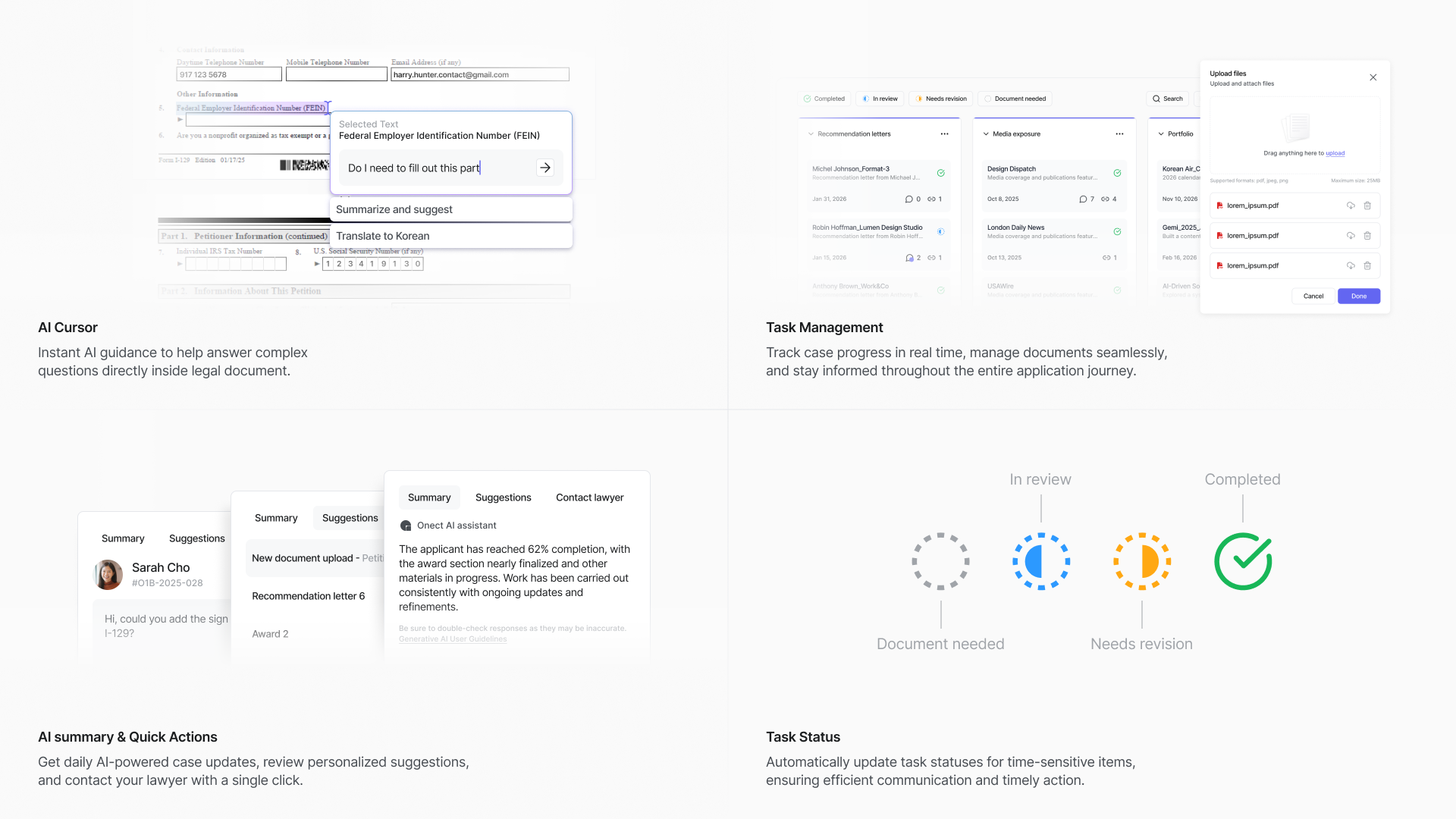
AI Cursor
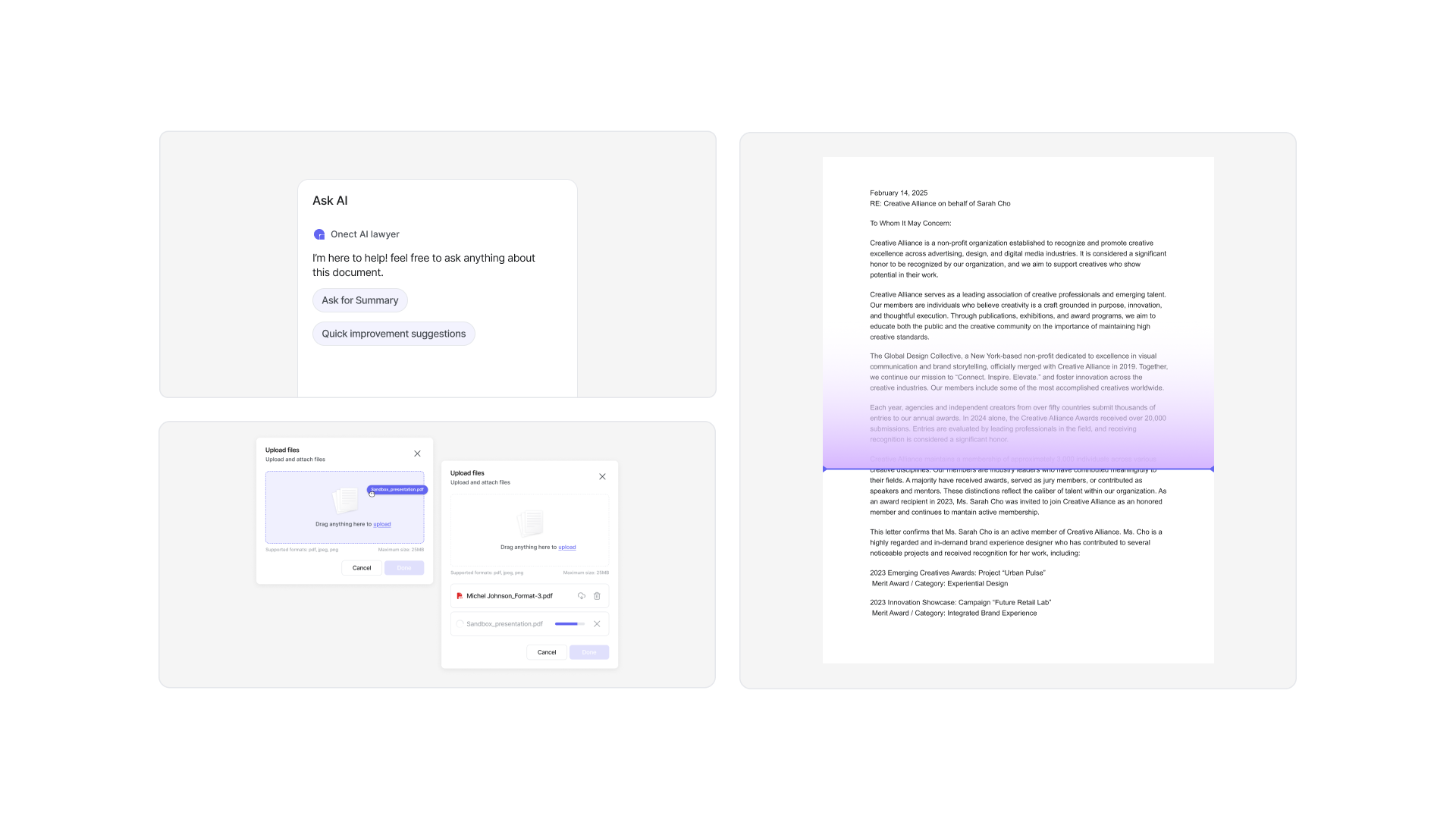
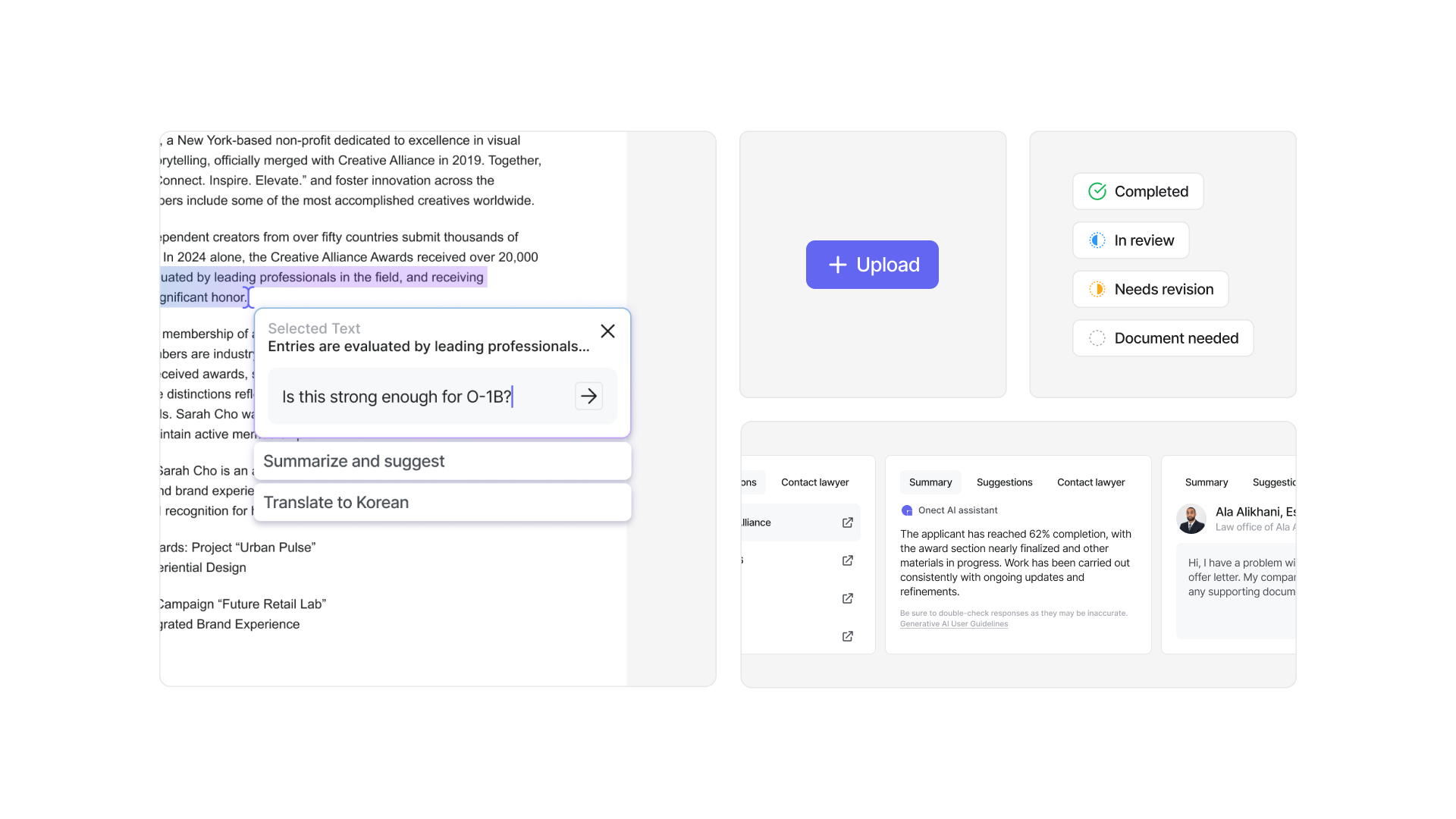
Helped users better understand complex legal documents through an AI-powered cursor.
00 · Project origin
How this started
Having gone through the O-1 visa process myself, I know firsthand how overwhelming it can be. I also saw the same anxiety among international colleagues navigating the process. Am I gathering the right evidence? Am I missing something important? Did my lawyer spell my name wrong? With little visibility into the process, even highly accomplished applicants were left second-guessing themselves.
Meanwhile, attorneys were buried in documents, cross-checking details, and trying to catch every mistake. The law wasn't the problem. The experience was. And I saw an opportunity to make it better for both sides.
Design challenge
How might we make the O-1 visa process clearer for applicants and more efficient for attorneys, without disrupting the way they already work?
01 · The problem
Two user types.
Completely opposing needs.

User 1 The applicant
Hiring a lawyer doesn't make the uncertainty disappear. Applicants still feel the need to double-check everything, from misspelled names to missing documents, even after paying $8K–12K for legal support. With limited visibility into their case, they’re left wondering whether everything is correct, complete, and ready to submit. The stakes are high: mistakes can put their petition at risk.

User 2 The attorney
For attorneys, the challenge is almost the opposite: managing multiple cases while reviewing hundreds of pages of evidence for each petition. Keeping track of documents, cross-checking details, and communicating updates across cases leaves plenty of room for oversights. Without a streamlined way to organize and review information, too much time goes toward manual checks instead of legal work.
When the process gets in the way
When the process feels this overwhelming, even qualified applicants can be discouraged from pursuing the opportunity in the first place. That’s what stayed with me: the problem wasn’t necessarily a lack of talent. It was a process that made proving it feel impossibly difficult.
02 · Goals & constraints
What we wanted to fix and what we couldn't ignore
What we wanted to achieve
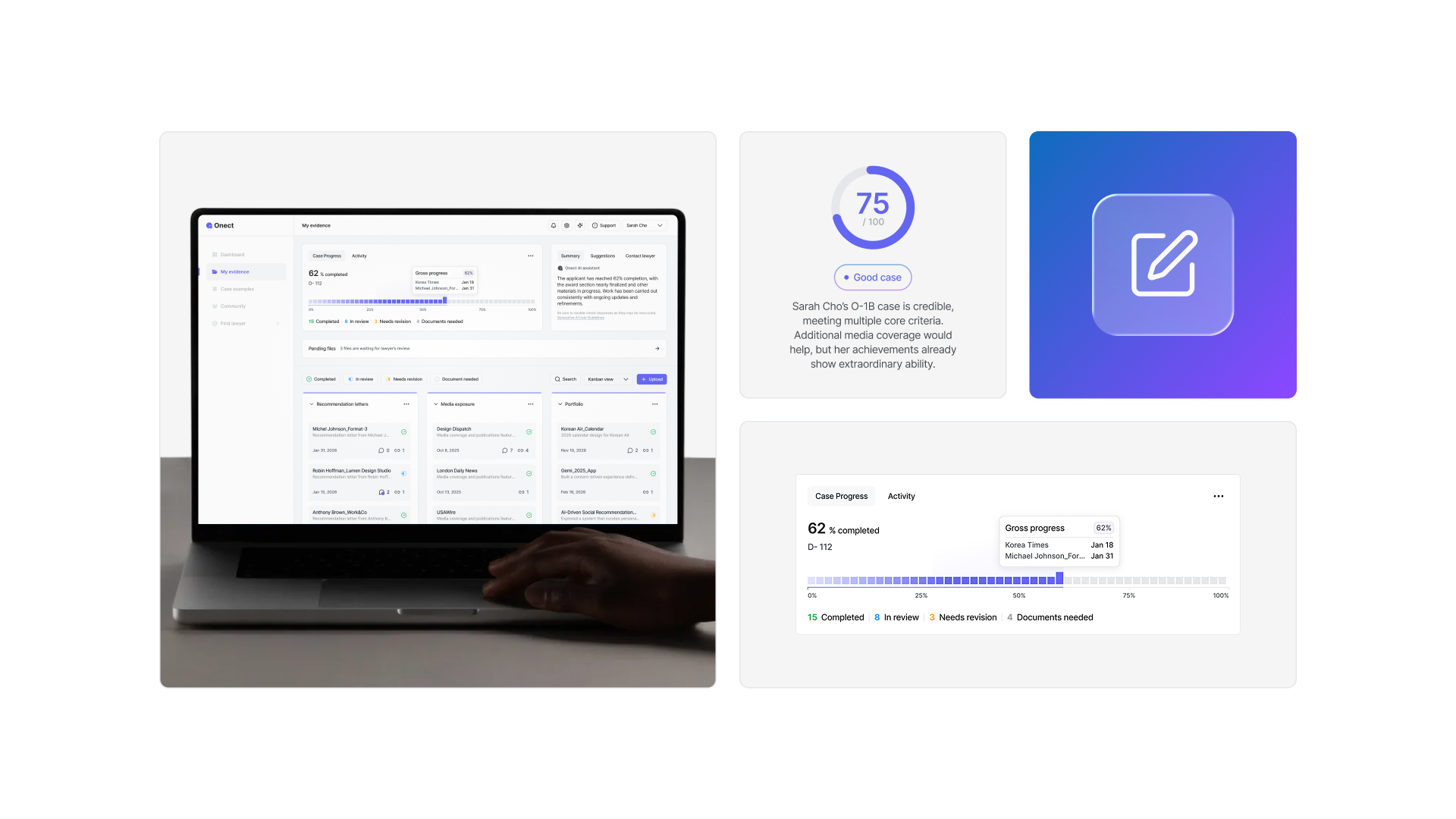
Give applicants a clearer path forward. Show case progress in real time and make the next step obvious, so applicants always know where they stand.
Help both sides find the right fit. Let applicants assess their eligibility before investing in legal fees, while helping attorneys identify promising cases earlier.
Take the busywork off attorneys' plates. Use AI to classify documents, flag potential errors, and reduce repetitive intake work.
Keep humans in control. Let AI handle the heavy lifting without taking legal judgment out of human hands.
What we couldn’t ignore
AI could guide, but not give legal advice. Every AI-generated insight needed to be clearly framed as informational guidance, not legal counsel.
Attorneys weren't going to start from scratch. Lawyers already had established document workflows. Asking them to abandon familiar tools and completely change how they worked would create friction before the product even had a chance.
03 · Research & insights
Seven conversations, one clearer picture
How we learned
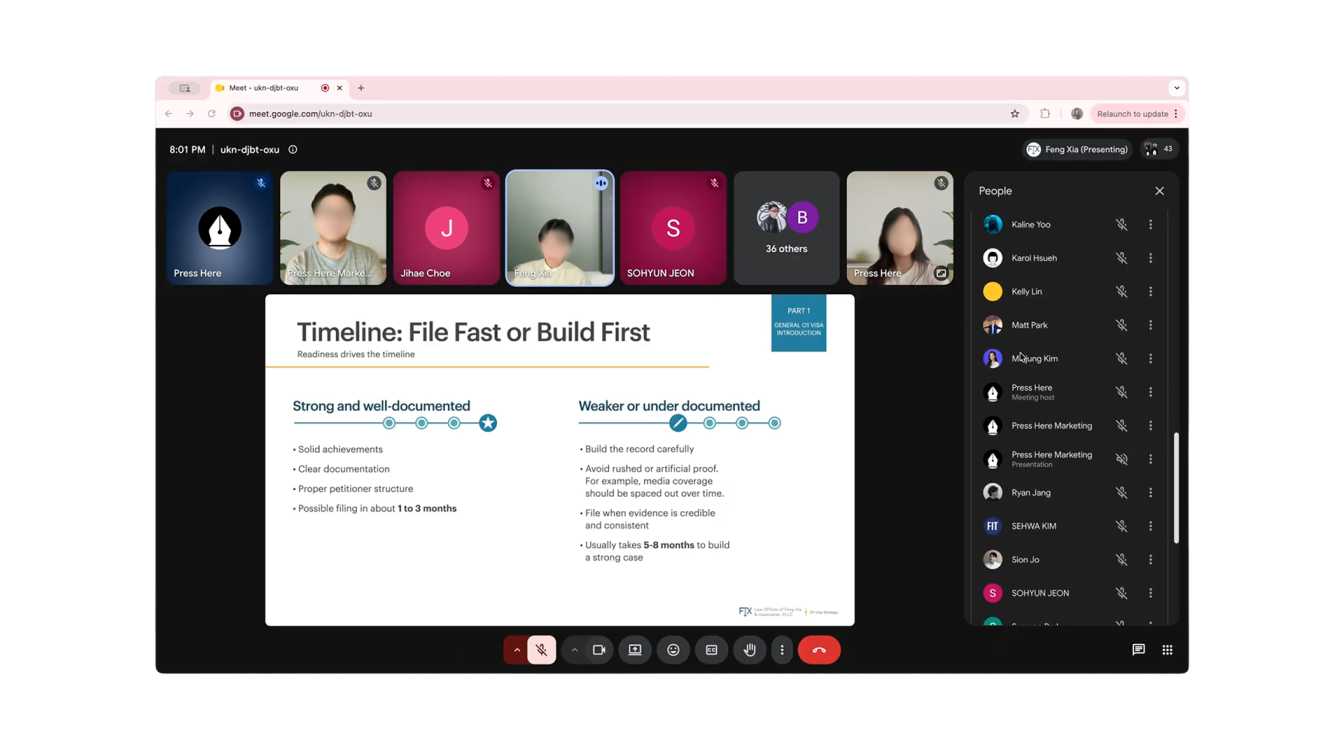
We spoke with four applicants who had recently received their O-1 visas and three immigration attorneys specializing in O-1 cases. Through empathy mapping and affinity mapping, we organized their experiences to uncover recurring frustrations and unmet needs.

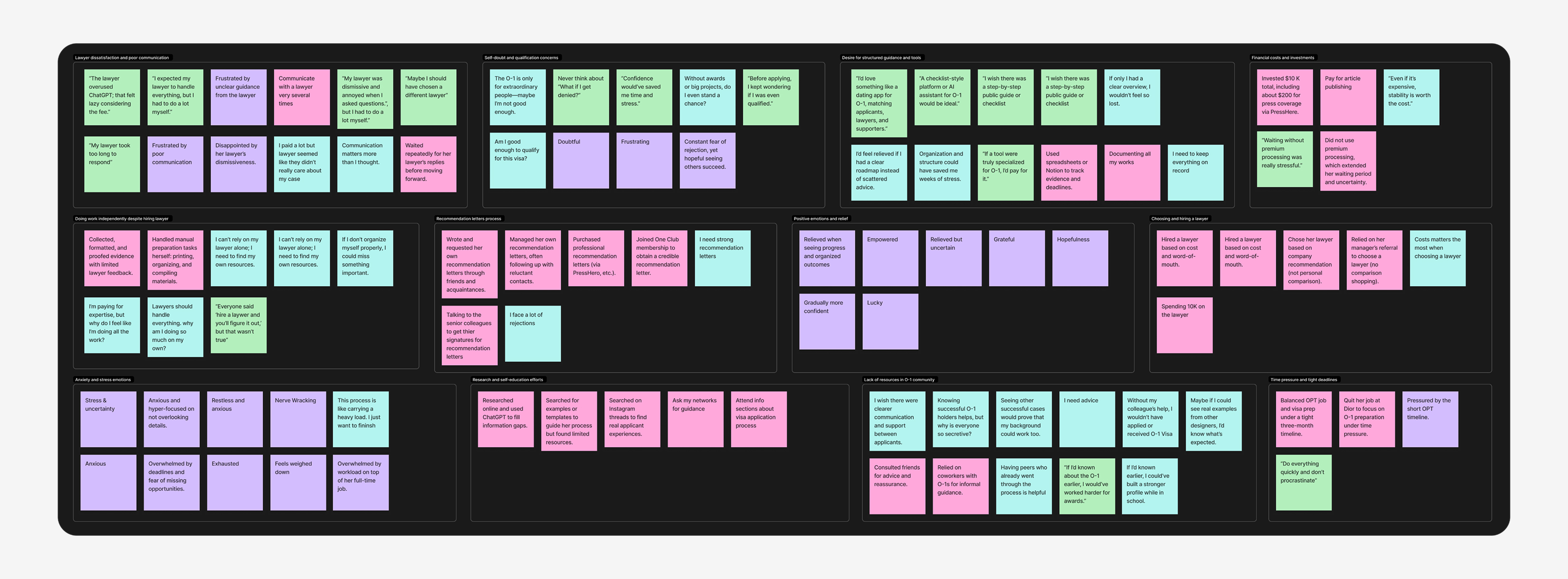
What we heard & Jobs-to-be-done
“Organization and structure could’ve saved me from weeks of stress.”
- Applicant B
“My lawyer was dismissive and annoyed when I asked questions, but I had to do a lot myself.”
- Applicant C
“A trustworthy platform must pre-qualify applicants accurately.”
- Attorney A
“We focus heavily on preventing RFEs (Request for Evidence) by having the highest quality of work.”
- Attorney C
“Clients often underestimate how much work it takes.”
- Attorney, Khalique Law
JTBD for applicants
Know where things stand. When my case is in progress, I want to see my status and next steps clearly, so I don't have to chase my attorney for updates.
Get unstuck on my own. When I don't understand a requirement, I want timely, accessible guidance so a simple question doesn't hold up my progress for days.
JTBD for attorneys
Identify the right cases early. When evaluating a prospective client, I want to assess their eligibility upfront, so I can focus my time on cases that meet the criteria.
Catch issues before they become bigger problems. When reviewing a petition, I want potential document errors flagged early, so I can focus on legal judgment rather than repetitive manual checks.
How we validated the findings
Beyond the interviews
Seven interviews gave us a starting point, but we didn’t want to rely on conversations alone. We cross-referenced our findings with publicly available USCIS data and audited eight existing tools to see whether these frustrations reflected a broader gap in the market.

What we found
Competitor analysis
Most existing solutions were built to support the mechanics of filing, not the experience of going through it. Attorney-facing tools focused on case administration, while USCIS resources explained the rules without helping applicants navigate their individual cases.
The bigger gap? No single solution we reviewed brought both sides together in a genuinely collaborative experience. Applicants were expected to gather the evidence; attorneys were left to make sense of it all.
That was the opportunity for Onect: build a platform that works for the people on both sides of the process.
04 · Finding the right direction
One platform, built for both sides
Applicants needed clarity and independence. Attorneys needed efficiency and control. Designing for both meant making an early decision: should Onect be one product with two tailored experiences, or two separate products built on the same foundation?
Getting this wrong would mean either forcing two very different users into the same experience or splitting them across disconnected tools that couldn’t share case information.
The direction was clear: one platform, designed around the needs of each side.
AI should do the heavy lifting, not make the final call.
We could have automated more. But in a legal process, a confident-sounding mistake can have real consequences.
So we drew a line between what AI could handle and what required human judgment. AI could organize documents, flag potential issues, and surface useful insights. But consequential decisions stayed in human hands.
Because the goal wasn't to remove people from the process. It was to give them better information, less busywork, and more confidence in the decisions they make.
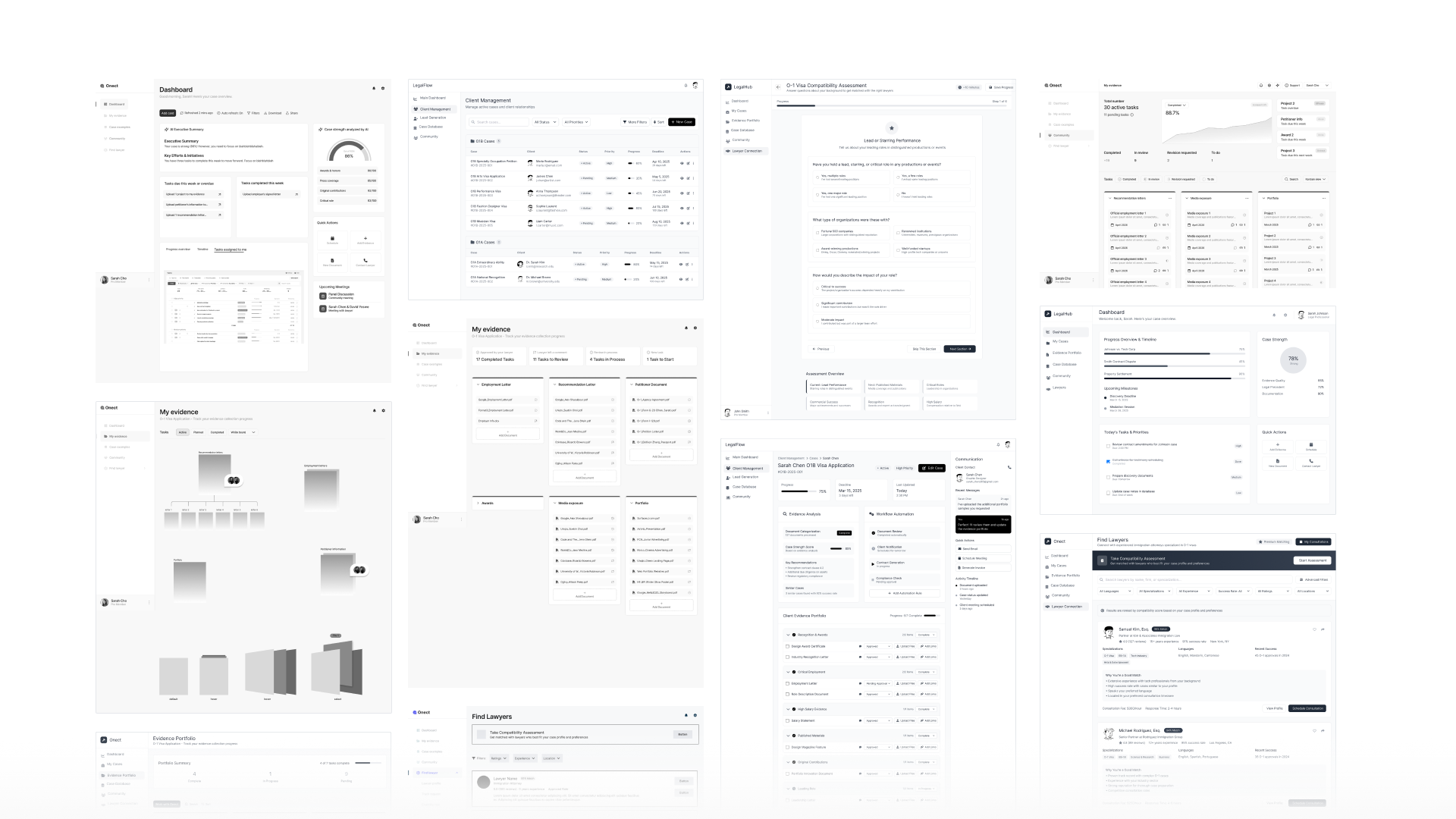
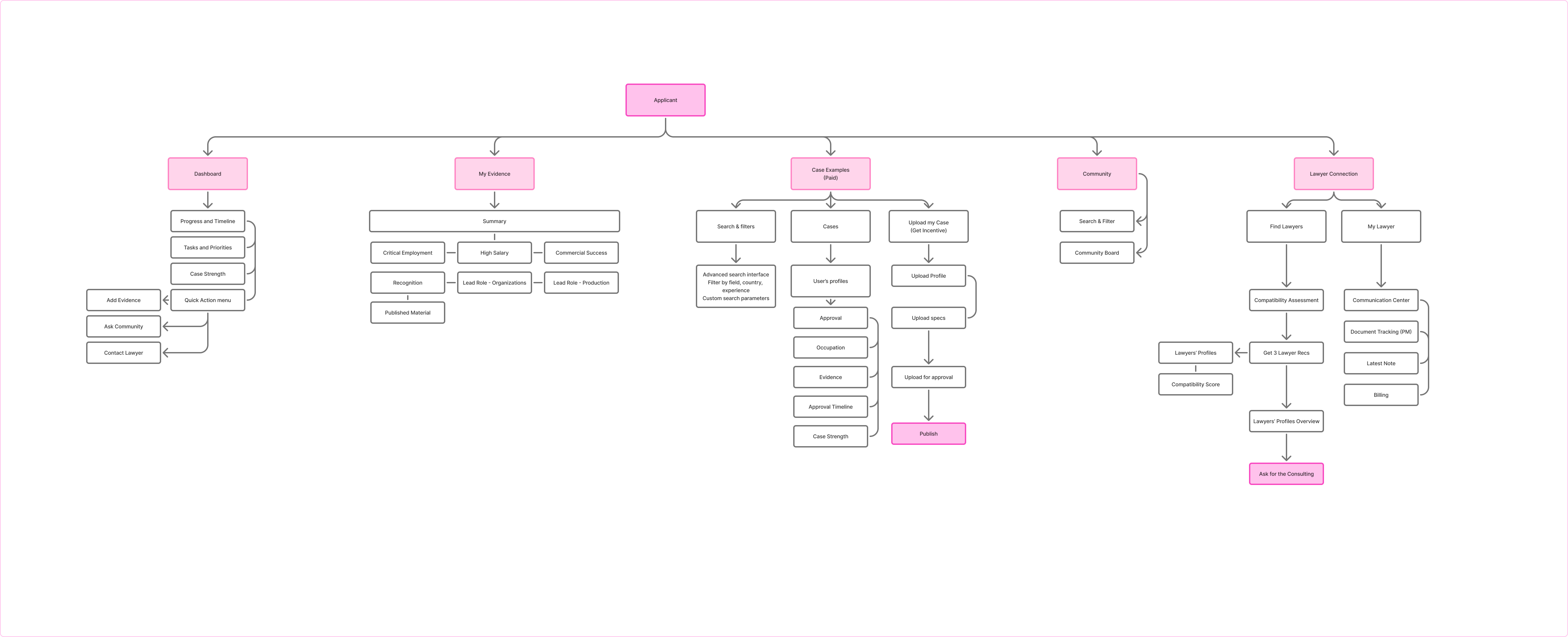
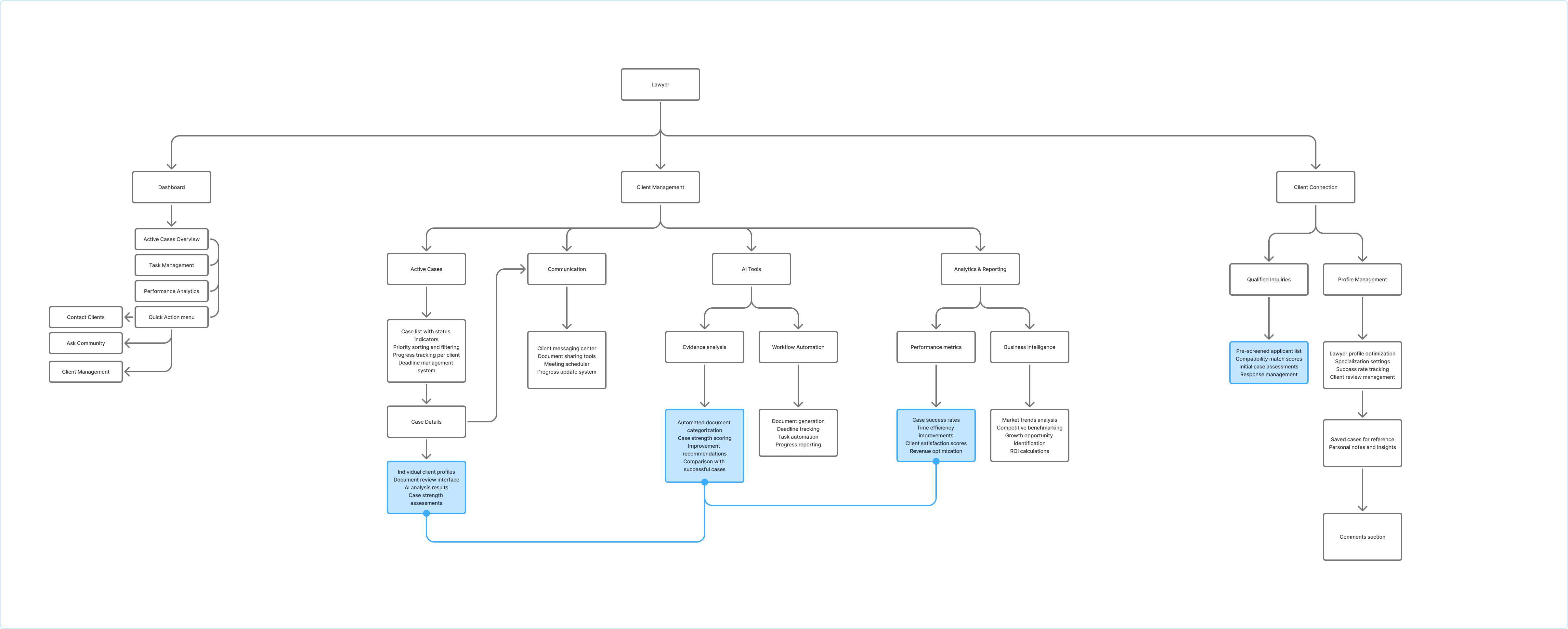
Wireframes for applicant and attorney experiences made with UX Pilot AI
05 · Solution
One platform, two tailored experiences
Onect AI brings applicants and attorneys into one connected platform, without forcing them into the same experience. Both sides work from the same case data, but each gets an interface built around their needs. Applicants gain clarity on their progress and what comes next. Attorneys get a more efficient way to manage cases, without having to abandon the workflows they already rely on.
Feature 1 · Applicant
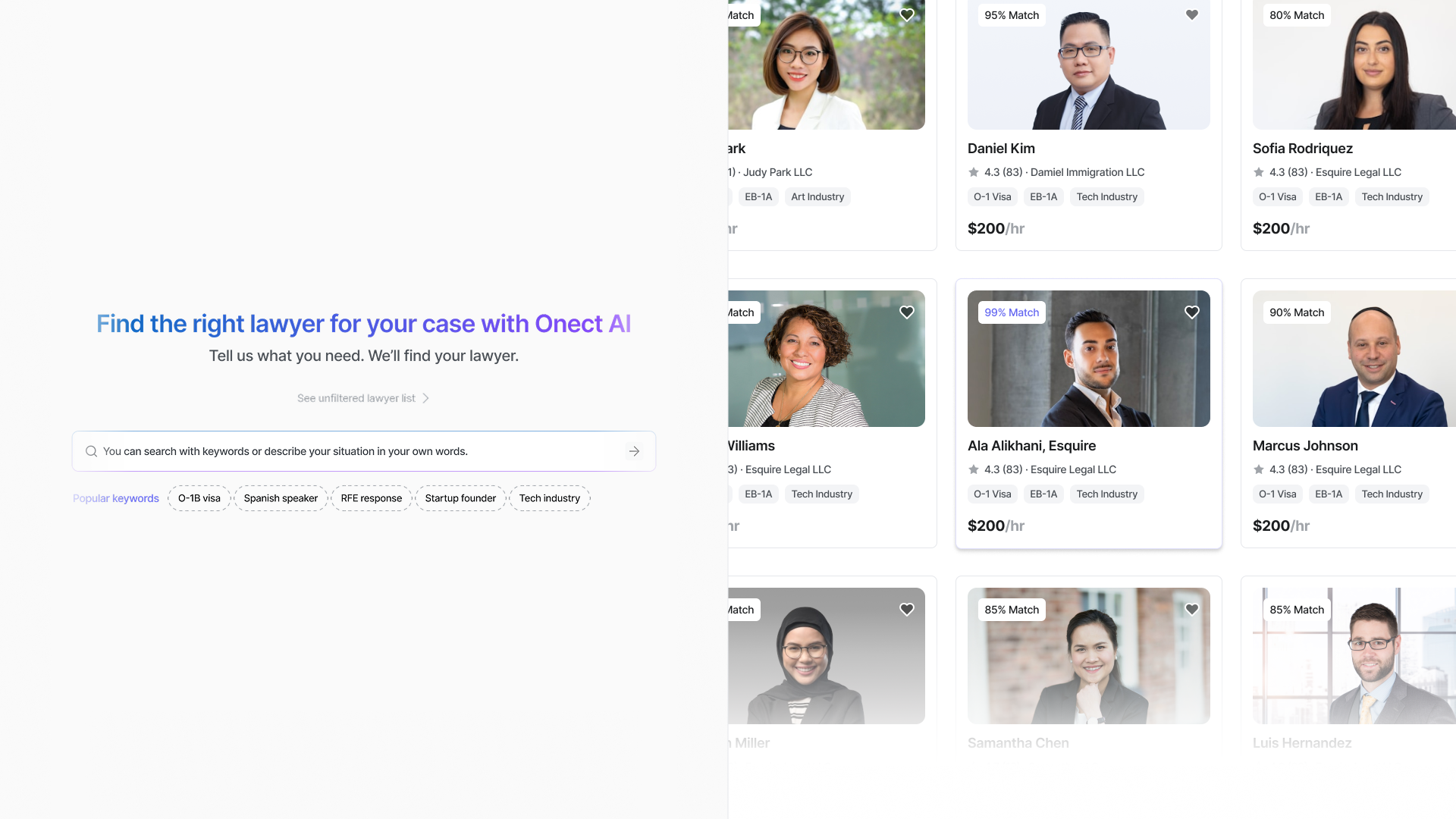
Eligibility check & smart matching
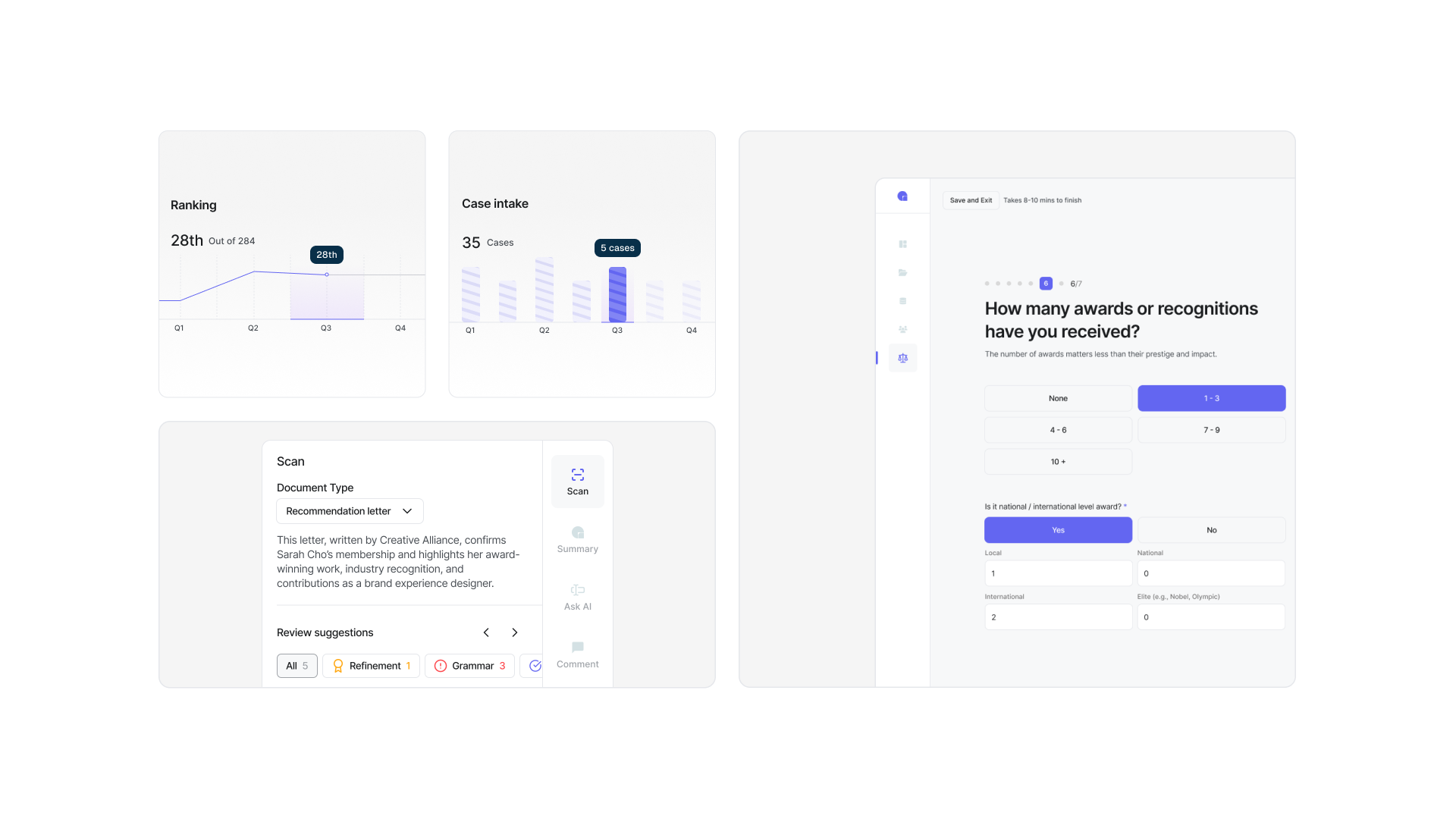
Before investing time and money in the process, applicants can finally get a clearer picture of where they stand, and find the right legal support for their case.
Feature 2 · Applicant
AI document assistant
Applicants shouldn't have to wait days or pay for a lawyer's time just to understand a document. The AI Document Assistant offers on-demand guidance, helping applicants make sense of complex legal requirements and move forward with greater confidence.
Feature 3 · Attorney
Intelligent document classification
Reviewing 100+ pages is already a lot of work. Having to sort through them before you can even begin is what makes it worse. Onect automatically classifies documents, so attorneys can spend less time organizing files and more time reviewing what matters.
Feature 4 · Attorney
AI powered document validation
AI validates application documents by detecting errors, inconsistencies, and missing information before they are submitted to USCIS.
06 · Design system
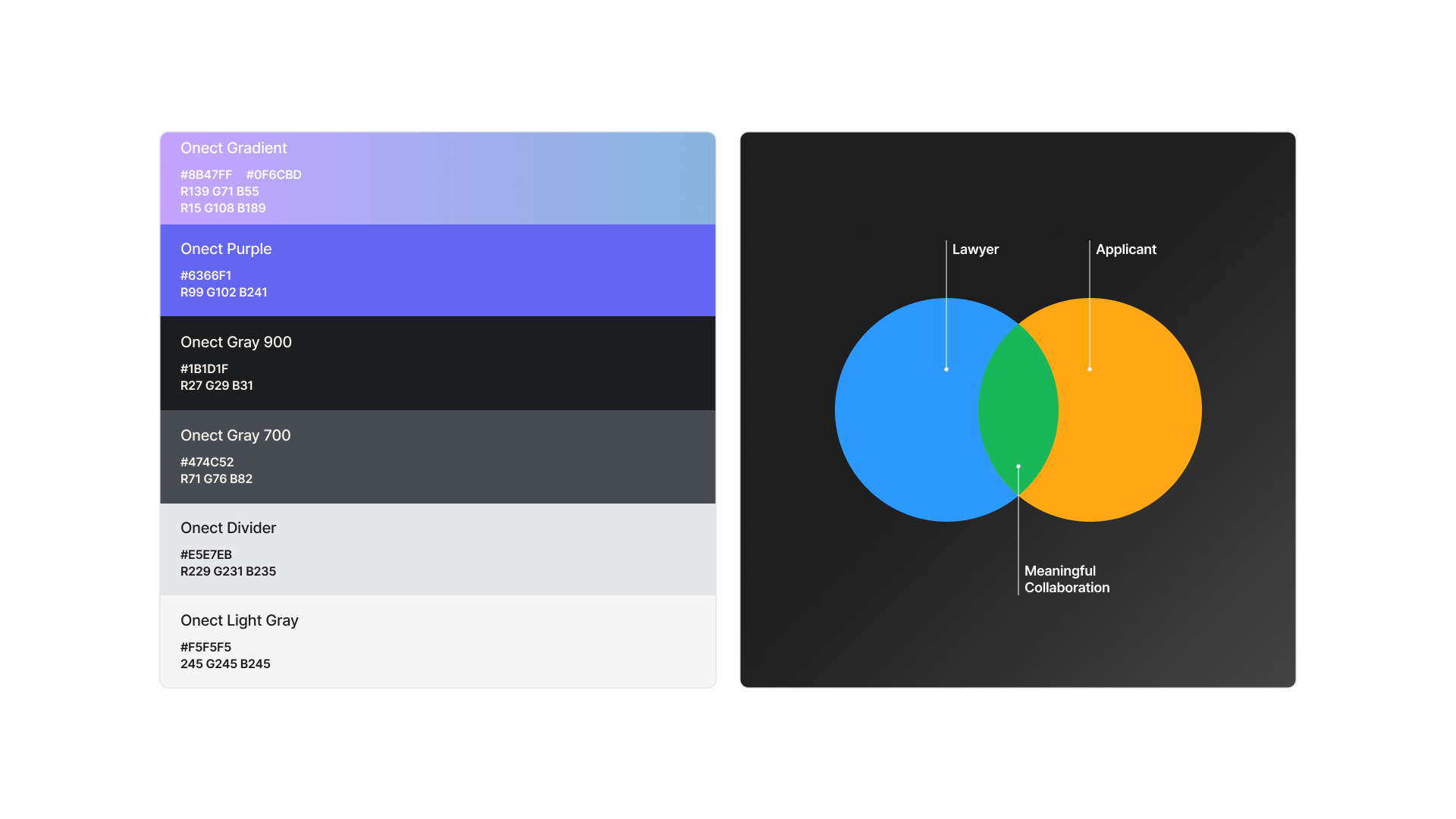
Making trust part of the experience
Onect needed to feel capable without feeling intimidating. The visual language had to communicate credibility and clarity while reassuring users that their most sensitive documents were in safe hands.
07 · Reflection
What I learned
Designing Onect meant holding two audiences in balance: applicants who need clarity and confidence, and attorneys who need control and efficiency. The hardest decisions were not visual, they were structural, especially where AI should assist versus where human judgment has to lead.
The project also reinforced how much trust matters in legal tech. Research and validation gave us direction, but credibility came from consistency across the experience, from copy and flows to the design system that carries sensitive work.
Browse projects

Airbnb Local
Reimagining Airbnb to help Gen-z turn online connections into IRL experiences that ease loneliness.
RE. UNIQLO X FIT
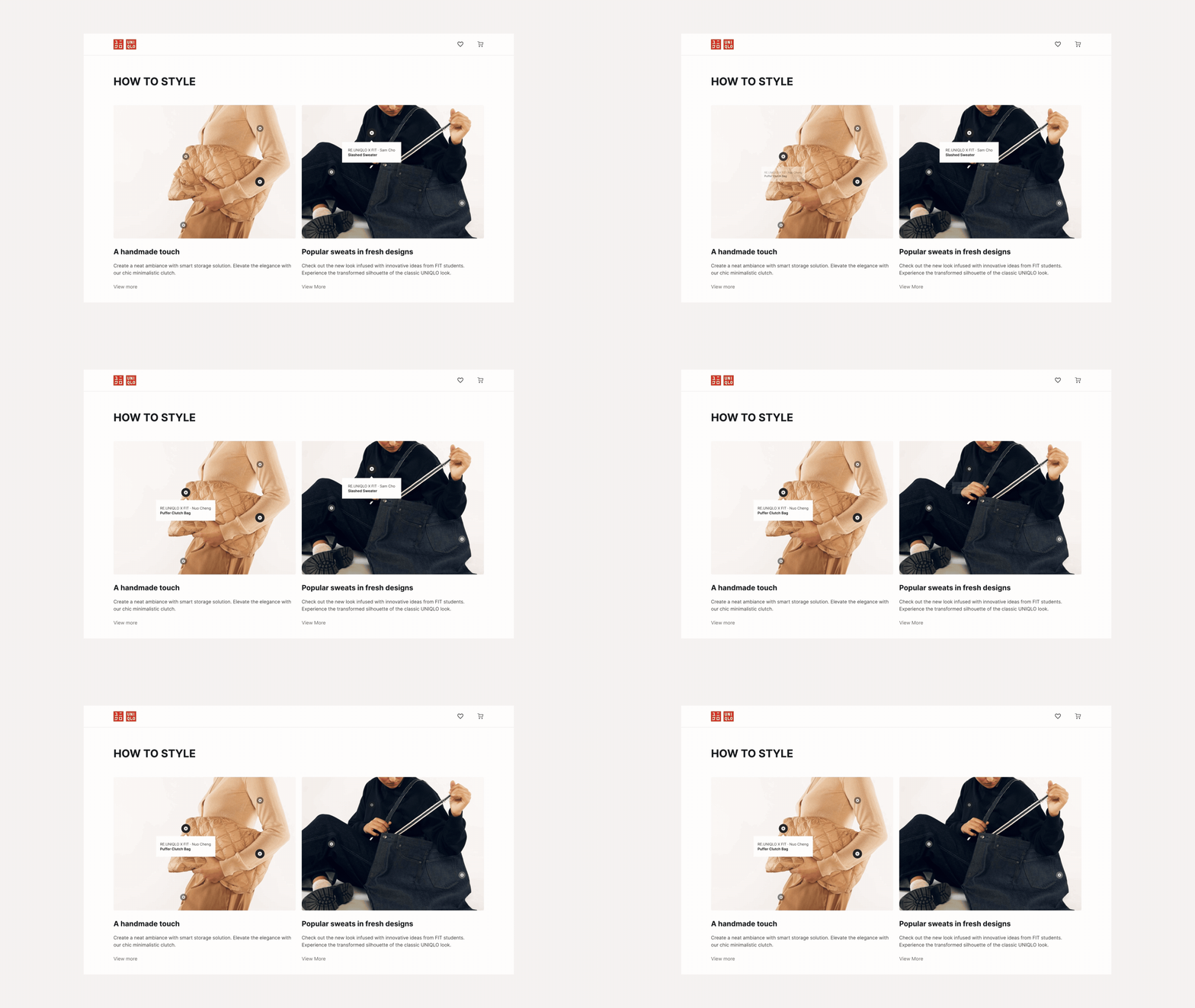
A live RE.UNIQLO X FIT landing page from FITDTech lab, focusing on simplicity and effective communication of FIT student designers' work with UNIQLO.

KCCNY X EnoB Spring Concert
Bringing spring’s sound to life with KCCNY x EnoB
HF Design Social Media Guide
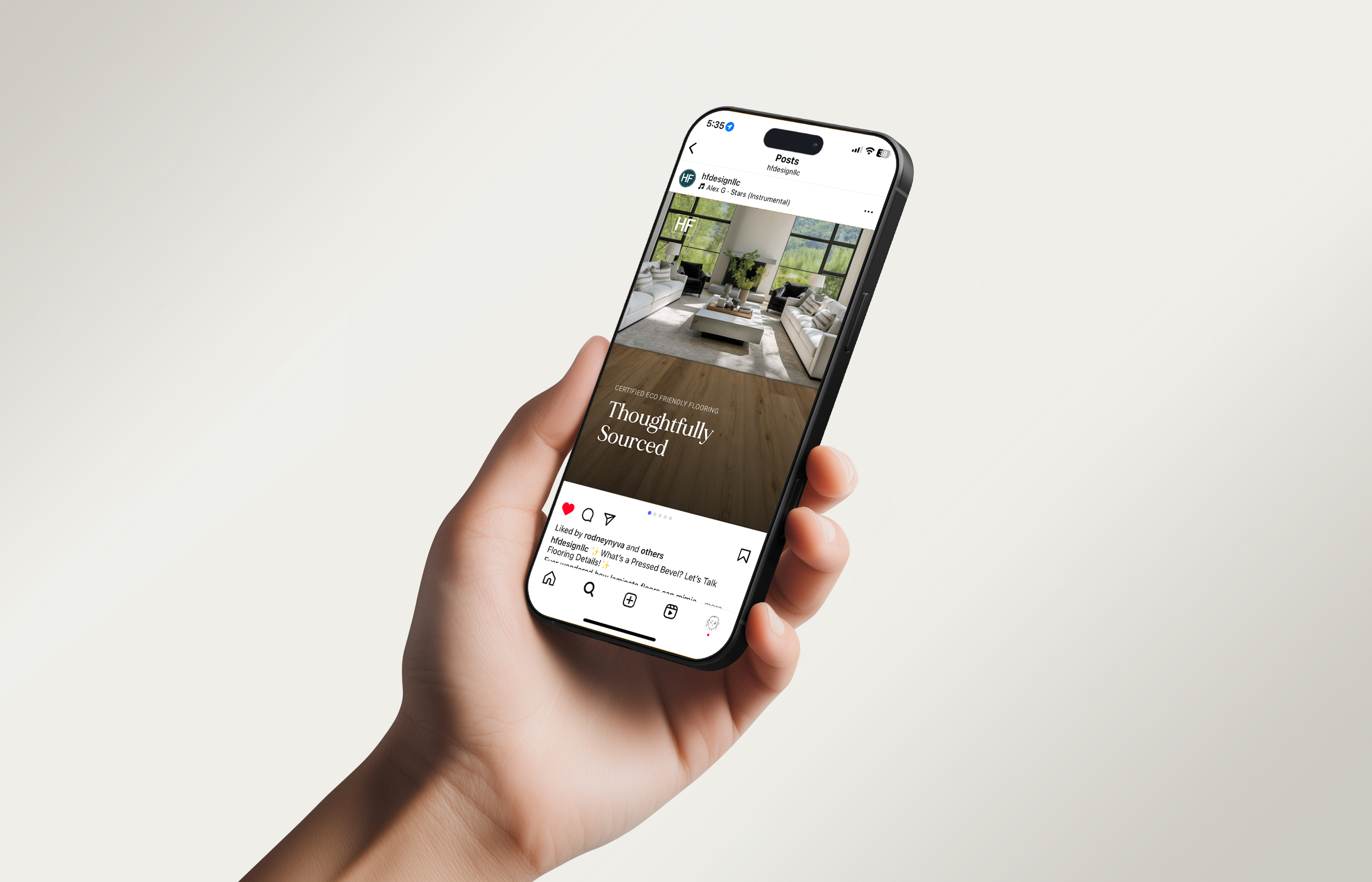
Creating a social media image guide for consistent brand identity
EnoB Branding
Rebranding for a non-profit organization aiming to create a sustainable design guideline and redefine visual storytelling to enhance brand's recognizability and practicality.